
A cash pool coordinates the money in several bank accounts – often across the companies in a group – so that a surplus in one account covers a deficit in another. But a cash pool is no magic liquidity solution. At heart, it's your perfectly ordinary bank accounts, fitted with transaction rules that even out deficits and avoid negative balances.
The transfers happen at fixed times or at set amount thresholds. But the bank doesn't know when the money is actually needed, in which account, or in which currency. Your cash flow forecast does, though – but we'll come back to that.
What actually happens in a cash pool?
Picture a company with three bank accounts:
- Account A holds SEK 2 million.
- Account B has a deficit of SEK 1.5 million.
- Account C holds SEK 500,000.
Together, the accounts show a surplus of SEK 1 million. Yet the company has to pay interest on the deficit in account B, while money sits idle in the other accounts.
This is where the cash pool comes in: a surplus in one account should be usable to cover a deficit in another.
There are two common ways to do it:
Physical cash pooling: "Real money" moves between the accounts. If one account has a surplus, it can be transferred automatically to an account that needs money. These automatic transfers are called sweeps.
Physical cash pooling comes in two main forms. With zero balancing, the accounts are emptied into a master account every day, so they stand at zero. With target balancing, a target balance is left in each account, and only what exceeds the target is moved.
Notional cash pooling: The money stays in each account. Instead, the bank adds up the balances and calculates interest on the total position.
In some cash pool set-ups, the accounts can also share a common overdraft. Instead of separate credit limits on each account, the company gets one shared credit facility that can be drawn wherever it's needed. That can reduce the need for credit and make it easier to use the company's combined liquidity.
Either way, these are ordinary bank accounts. The difference lies in how the balances are handled.
Bring the cash pool in-house
A physical cash pool, then, is accounts plus rules for when and how much money to move.
With Fluidly, building that logic yourself takes a few minutes. In the example below we create the first rule: "Sweep account A to account B every day at 4:30 pm":
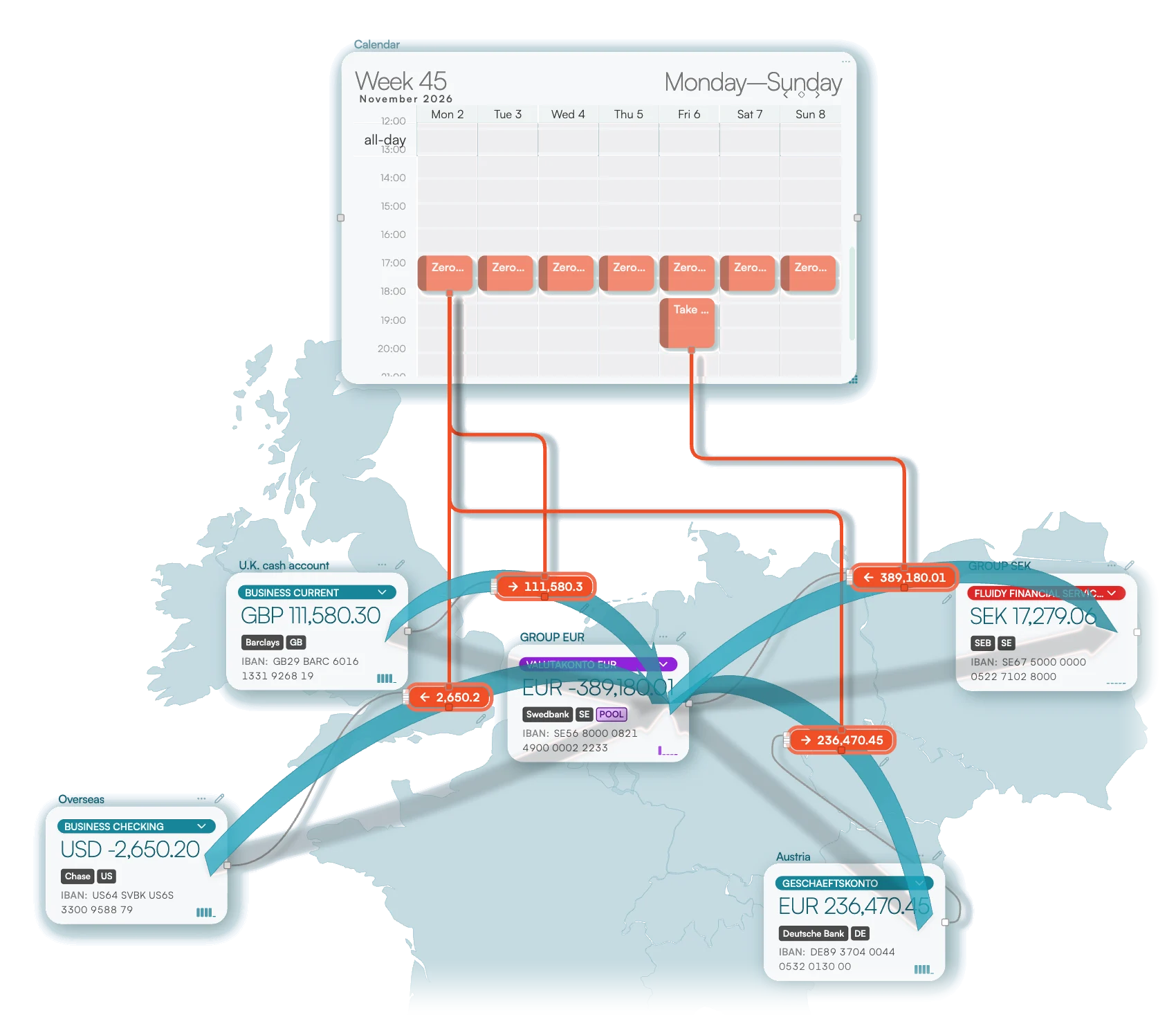
We've put a map of Europe in the background to make it extra clear what's happening. Note that the Transaction needs an amount, and we give it the account balance – that makes it a sweep.
You can also have the transfers driven by clicks, amounts, positions or exchange rates(!).
The bank still provides the accounts, the security and the payment infrastructure. The rules are the only thing we've taken control of.
The transfers are initiated through the banks' PSD2 interfaces. That means Fluidly can send payment orders between your own accounts without you having to set up each transfer by hand in online banking. The bank receives the payment order and carries out the transfer.
Connect the cash flow forecast
Now let's teach our cash pool to predict the future! This assumes you've done your forecasting work. To keep things simple, we'll stick to a single currency, but the example below can be duplicated for every currency the company handles.
By connecting our Forecast to a Statistics node that extracts the dip ("lowest balance"), we get the amount that needs to be in the account. We also make sure the Forecast filters on "tomorrow", so that it's tomorrow's lowest balance the Statistics node picks out.
And here's the beauty of it: if the amount is negative, Fluidly reverses the direction of the transaction! The same goes for currency exchanges. That's the property that lets us simplify very complex end-of-day flows so radically.
So we've gone from a simple rule that moves money at a set time to a cash pool of our own that takes into account what will actually happen in the accounts. Does an account need money tomorrow? Then that's where the money goes.
It's only when we connect the cash pool to the forecast that things get really interesting. We no longer move money just because a balance is negative. We mobilise it based on the company's actual liquidity needs.
Let's finish with a proper reward for the effort: is there a surplus? Then we can easily build a rule that moves the remainder to an interest-bearing account! If you've built your forecast with Fluidly's components for rounding and payment runs, it takes a couple of minutes to configure your cash pool so that it earns interest on ALL the company's liquidity six days out of seven – all year round.
Take control of your liquidity
The bank can even out balances. But so can you. And you can also steer liquidity by what the company actually needs – and make sure the money works while it waits.
Want to see it on your own accounts? Get in touch and we'll show you how to bring your cash pool in-house.