
The same visual freedom. A whole new experience.
We have rebuilt Fluidly from the ground up. Not because we changed our minds about how finance work should be done, but because we finally have the technology to do the vision justice.
Fluidly has never been an ordinary finance application with ready-made views, menus and workflows that fit everyone and no one. Here you build your own canvas. You drag out components, connect them and shape your flows around how your business actually works.
The idea has carried us from the start, but Fluidly 1 was built on Node-RED, a flow-based development platform with its roots in the IoT world. It was a little too free and not quite what a CFO or controller needs to face when the working day begins. The UX was needlessly clunky, and performance had its limits.
So we took control of the whole technology stack, and the result is Fluidly 2.0.
Built from the ground up.
We have replaced the entire technical foundation. The front end is now built in Svelte, a framework that lets us create a considerably faster and more efficient interface. For the back end we chose Elixir/Erlang – proven telecom technology with a long track record of handling huge numbers of simultaneous connections and strict availability requirements. Erlang runs large-scale systems at Klarna and WhatsApp, among others.
We have also built an entirely new database layer based on event sourcing, slimmed down the client and rewritten memory management. That makes Fluidly both faster and leaner on memory.
You'll notice. Not just when you open the canvas, but when you slice and dice three years of transactions — all 100,000 of them.
And a new, fresh, light theme (dark mode still looks like Fluidly 1.0).
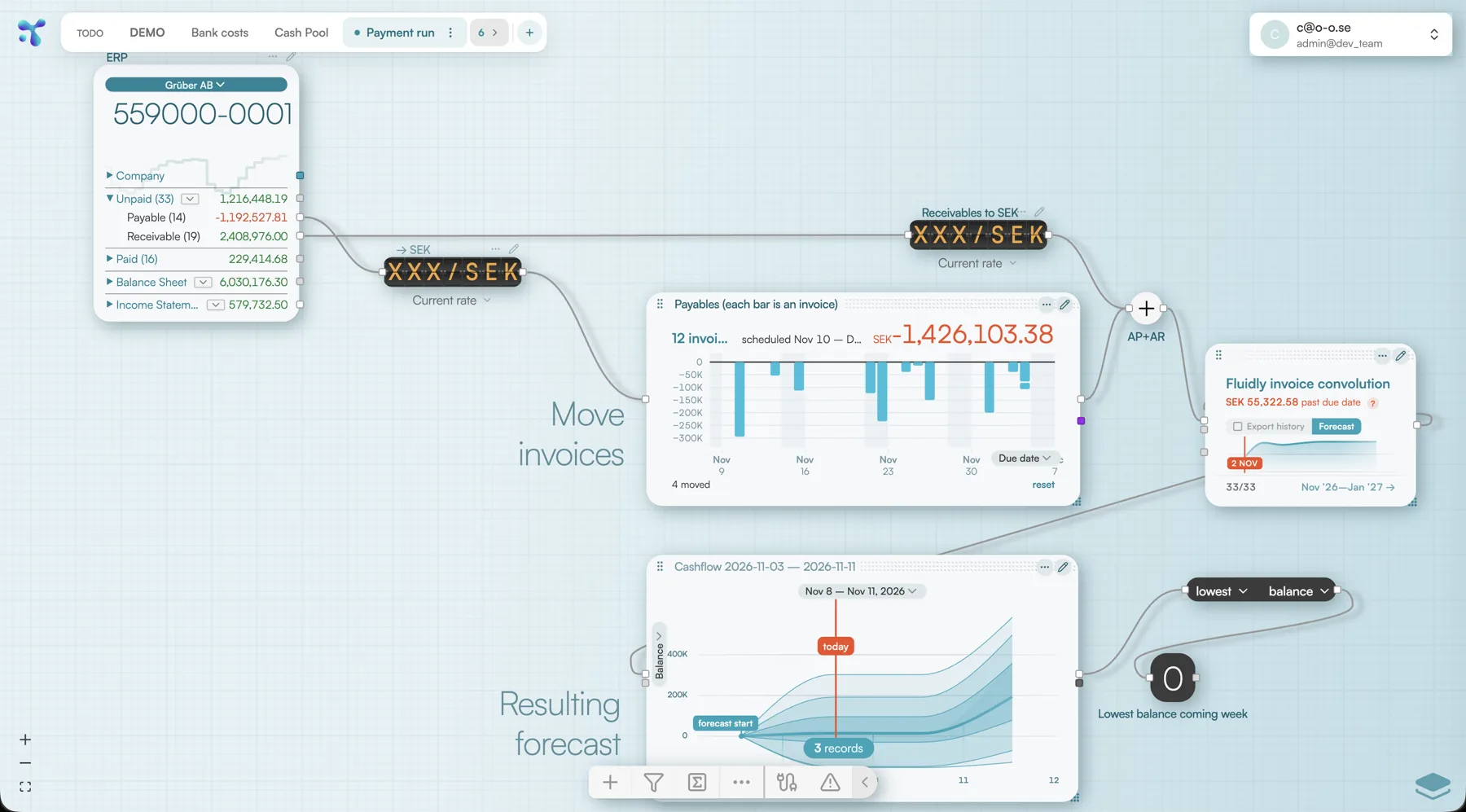
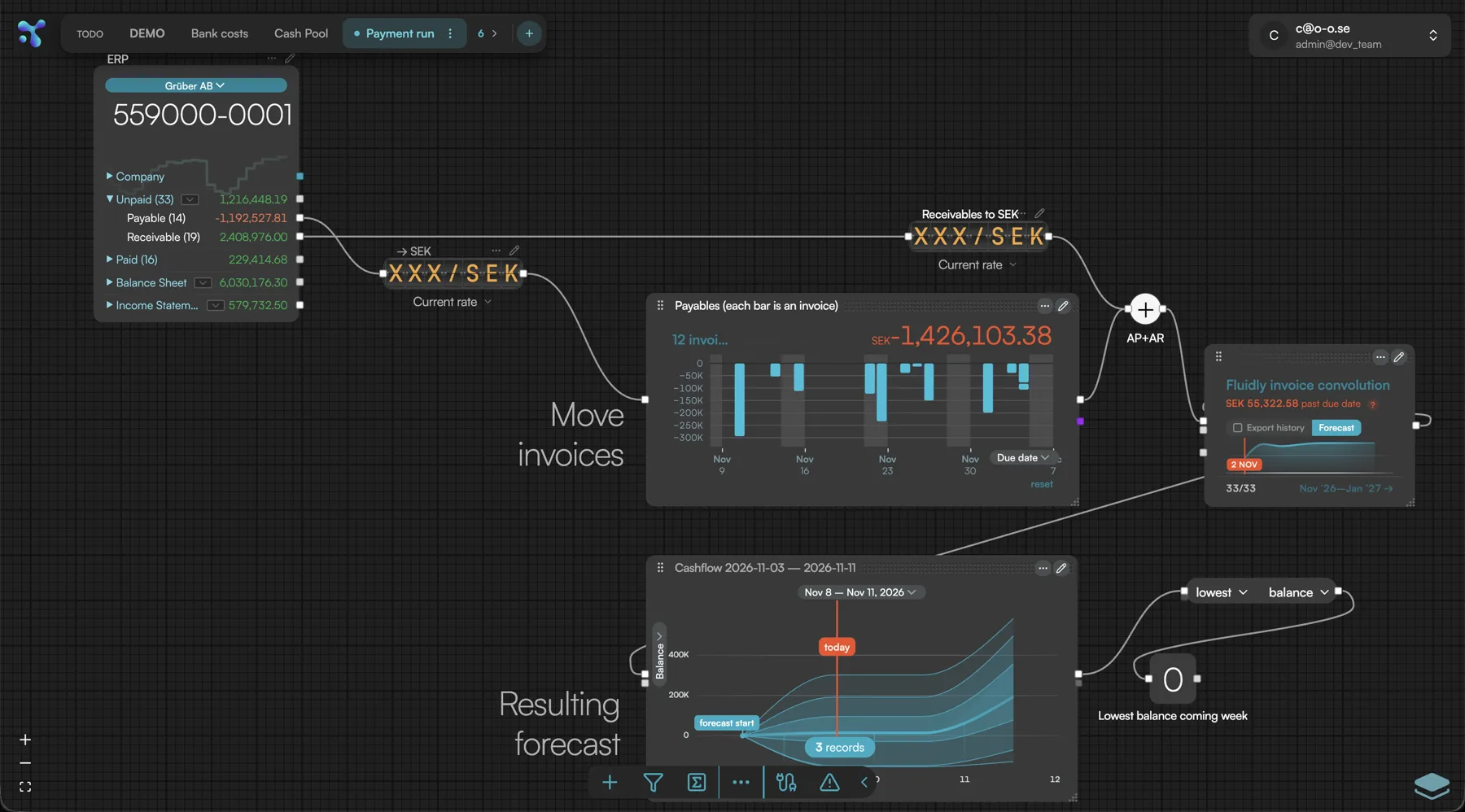
A canvas shaped like your business
Fluidly has no ready-made views you have to adapt to. You decide what goes on your canvas, how the components connect and what information is shown.
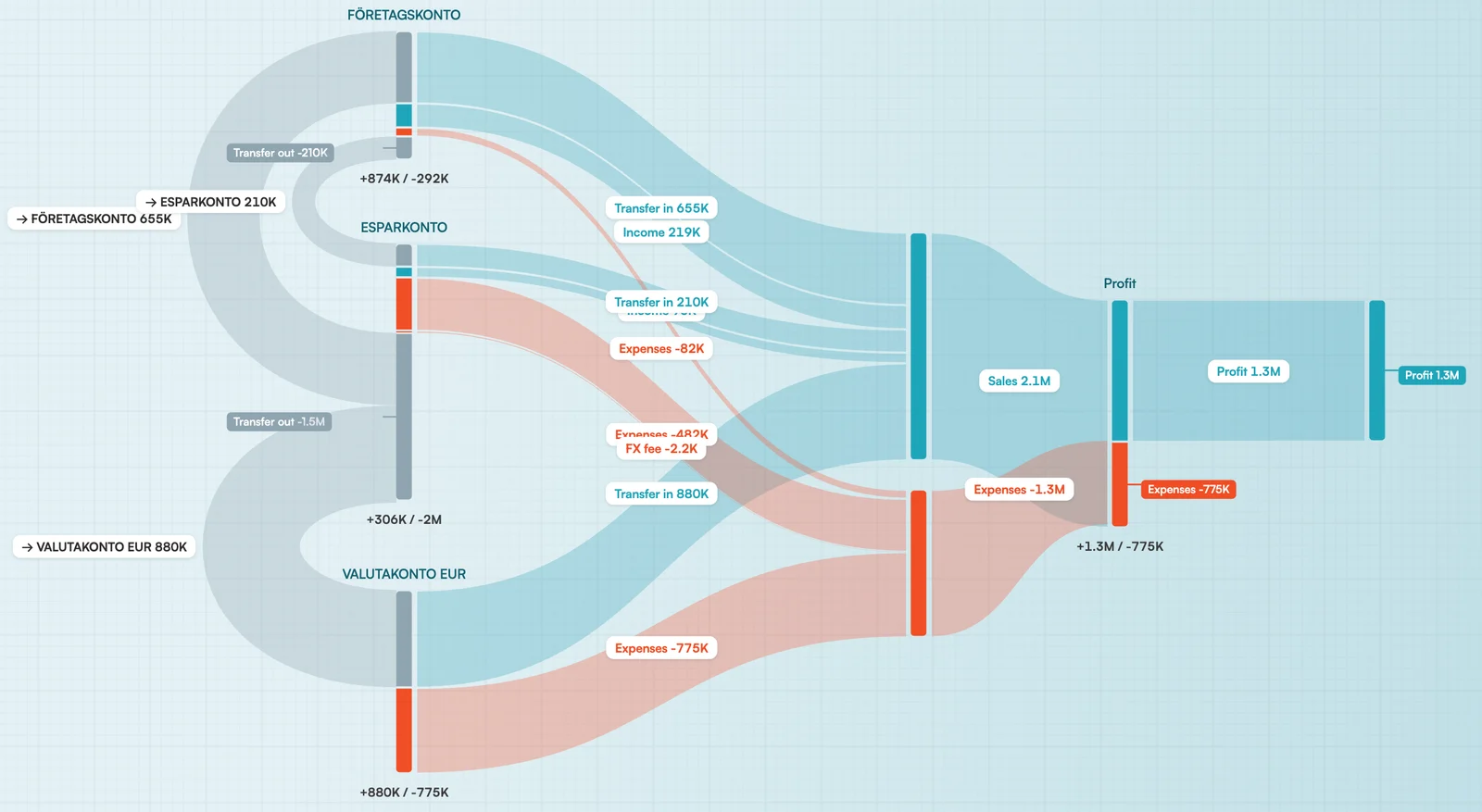

In 2.0 we have taken the visual side a step further with layers. You can put things in the background without them getting in the way of the flow itself: maps of the countries where the business operates, say, or a HUUUGE cash flow forecast. These decorations become the backbone of your canvas, not yet another view you have to click your way to.
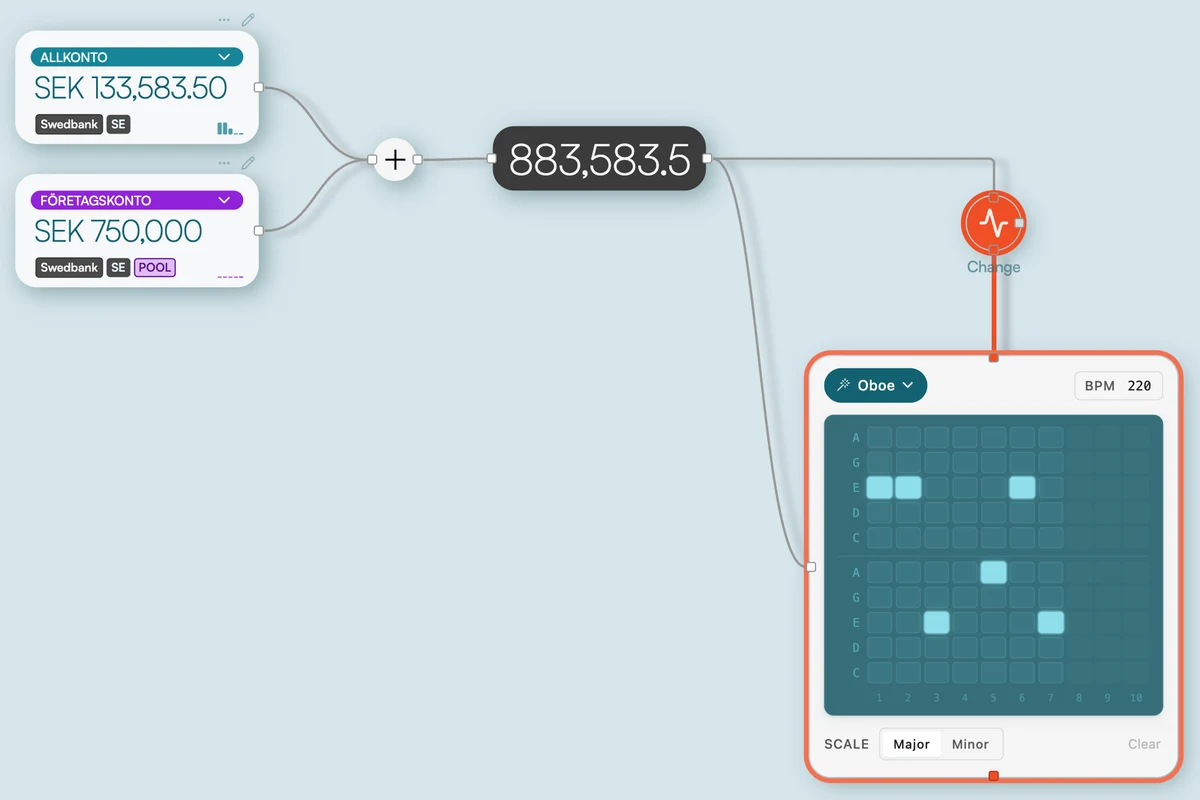
We have also added sound. With PlaySound you can attach sounds to account events and other values. Want to hear when the balance changes? Or give each currency its own sound? It may not be the first thing a CFO asks for, but it says something about what happens when you stop thinking of finance as tables and start thinking of it as components. (PlaySound can also play your amounts for anyone who would rather listen to their liquidity.)
Real-time collaboration
Several users can work in the same Fluidly environment at once and see each other's cursors. So you see not only what a colleague has built, but what they are doing right now.
It is real remote, financial collaboration. Nobody has to send a screenshot or attach Copy of (27) Cash budget.xlsx. You work together on the same canvas.
Automation for financial services
This is by far the biggest change.
Fluidly 1 was built on Node-RED and inherited its way of handling automation. It worked, but there was an odd contradiction: the flow looked visual, yet to understand what was actually happening (especially when debugging) you would have to double-click nodes, read code and dig through hundreds of messages. You find the same paradigm in Zapier, Make and n8n.
We have built that away.
Fluidly 2.0 has a new (and novel) automation engine, built to handle financial flows visually all the way through. We have separated two things that traditional automation tools mix up:
- Control flow: Is the flow active or inactive? Yes or no. Red or green.
- Data flow: What values and what information pass through the flow?
The difference is enormous when the data is separate and visible: Never hidden data in messages. No need to open a node and read code to understand why something happens. In fact, no code at all!
The engine also handles more advanced structures such as diamonds and branches in a way that is hard to achieve in classic visual automation tools.
AI on your terms
We also have a firm view on where AI belongs in a financial application: not between the bank and the user. Each number you see in Fluidly is derived the old-fashined way: deterministically, keeping full traceability all the way to your bank accounts and ERP.
Why? Because otherwise we would never dare to put an automation layer on top, and you would probably not dare to use it.
If you want to use AI, you connect the data sources you want to ask about to an AI component yourself. Then you see exactly what is sent along with the prompt to the AI service you have chosen. Nothing else comes along for the ride.
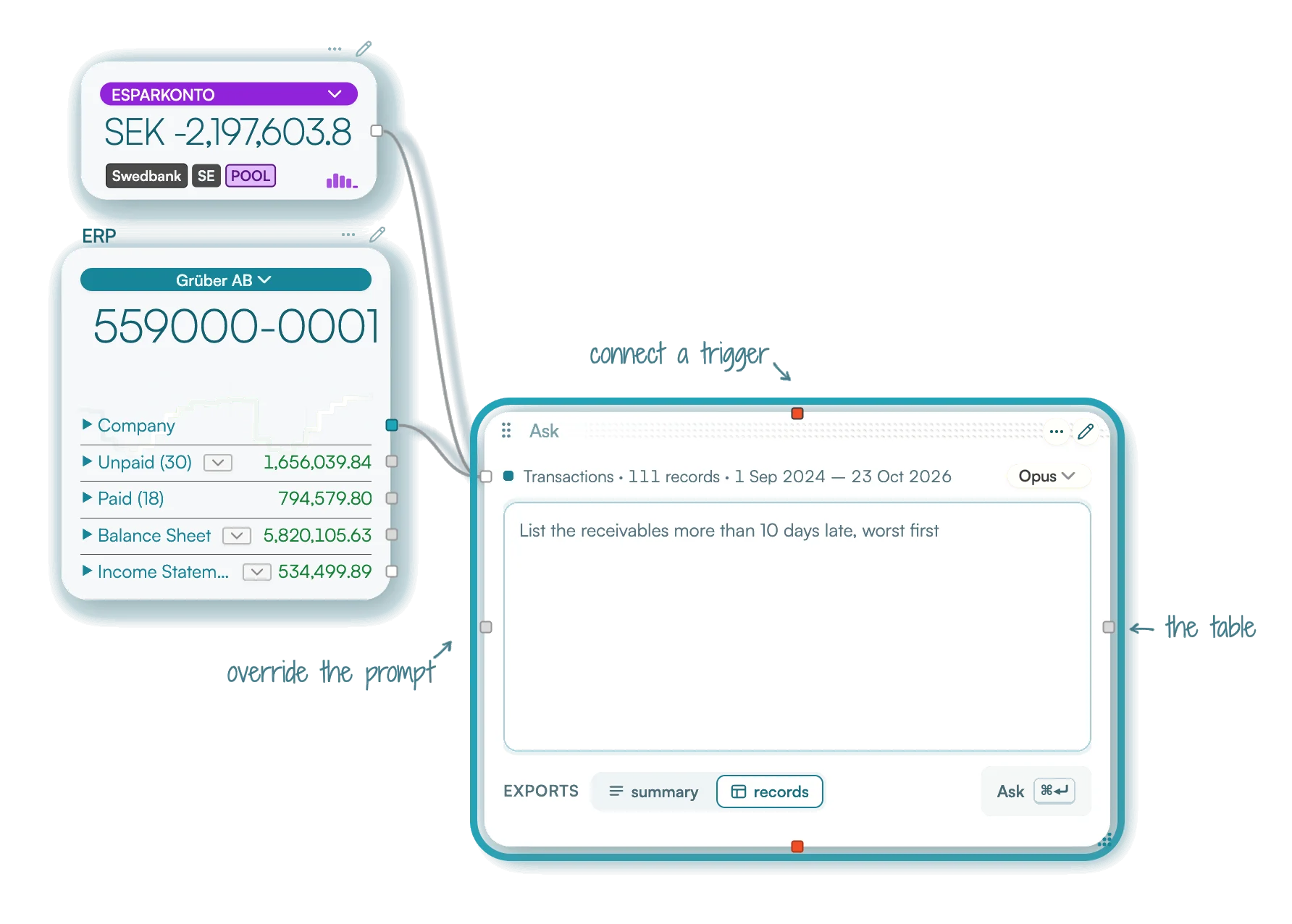
The AI component can be used in several ways: you can ask questions directly in Fluidly, connect to it over MCP, or let it run automatically as part of a flow.
Say you connect all your bank accounts to the AI component. A calendar event at eight every morning triggers the question: "Give me a report on the change in liquidity since yesterday." After the AI component sits an email component that sends the report, in plain prose, to the management team. The flow takes about 50 seconds to build, depending a little on how fast you can type "Give me a report on the change in liquidity since yesterday."
And there is an important division of responsibility here: whoever writes the prompt is responsible for the question, for judging the answer and for how the conclusions are used. Fluidly is responsible for fetching, handling and presenting the data with traceability back to its source.
From seeing your liquidity to steering it
A faster, more stable platform is nice, of course. But what is interesting is what it makes possible.
You can build a cash flow forecast that shows not just an expected balance, but the probability of different outcomes. You can move payments in time and see right away how that changes the risk of running out of cash. You can build your own cash pool across banks(!), that takes your forecast into account, not just what the balance happens to be at a given moment.
And you can tie all of it together with automation that moves money, reacts to liquidity dips and exchange rates, and makes sure the surplus ends up where it does the most good.
This is where the visual canvas becomes more than a different interface. It becomes a tool for building, graphically, exactly the financial logic your business needs.
And now the fun begins
Fluidly 2.0 is a milestone, but not the finish line.
We want a company's money to always be working: either it is on its way to a customer – from the right account, in the right currency and at the right time – or it is sitting in an interest-bearing account. Nothing in between.
That takes more than a forecast and your own cash pool. It takes a company's financial flows being connected and steerable as a whole. It takes Flu… well, you get the idea.